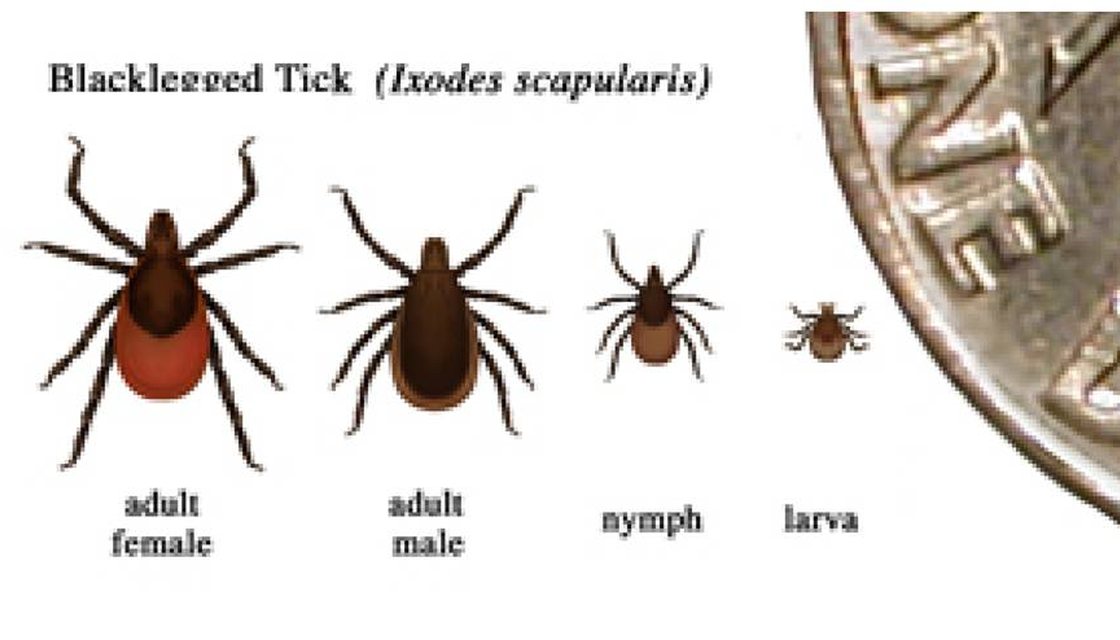
Blacklegged ticks have spread across southwest Michigan. They wait at the tree line, not in the middle of your lawn.
They don't jump, they wait
Ticks do not fly, jump, or drop from trees. A blacklegged tick climbs onto low vegetation, extends its front legs, and waits for something to brush past. The behavior is called questing, and it requires humidity, because a tick sitting in dry sun dehydrates.
That single fact tells you where they are. Leaf litter, tall grass, brush, and the shaded edge where a lawn meets woods hold nearly all of them. A mown, sunny lawn holds very few.
Why southwest Michigan
The blacklegged tick, also called the deer tick, has expanded steadily across southwestern Michigan over the past two decades, and with it Lyme disease. Calhoun County sits in that expansion. Wooded lots, river corridors, and the mix of yard and woodlot that defines a lot of Battle Creek, Bedford, Marshall, and Augusta property is exactly the habitat.
Nymphs are the ones that matter most. They are about the size of a poppy seed, active in late spring and summer, and responsible for most transmission simply because people do not notice them.
Reducing the habitat
This is landscaping more than chemistry. Keep the grass short. Rake and remove leaf litter, especially along the borders. Cut back brush at the tree line. Move woodpiles and bird feeders away from the house, since both concentrate the rodents that carry ticks. Discourage deer from the yard.
A three-foot strip of gravel or wood chips between the lawn and the woods measurably reduces tick movement inward. It is a simple and durable improvement.
Treatment is edge work
Because ticks concentrate at the boundary, treatment concentrates there too: the wooded edge, the leaf litter, brush lines, stone walls, and the transition zone, rather than a broadcast across the open lawn. Timing targets the nymphs in late spring and the adults in fall.
A local pro will treat the edge, address the leaf litter, and tell you where the rodent hosts are traveling, because that is what sustains the population.
Personal checks still matter
No yard treatment replaces a tick check. After time outdoors, check the scalp, behind the ears, the armpits, the waistband, and behind the knees. Remove an attached tick with fine-tipped tweezers, gripping close to the skin and pulling straight out.
If a rash, fever, or flu-like symptoms follow a bite, see a doctor. Lyme disease responds well to early treatment, and the timeline is what matters.
Call and connect with an experienced local exterminator.