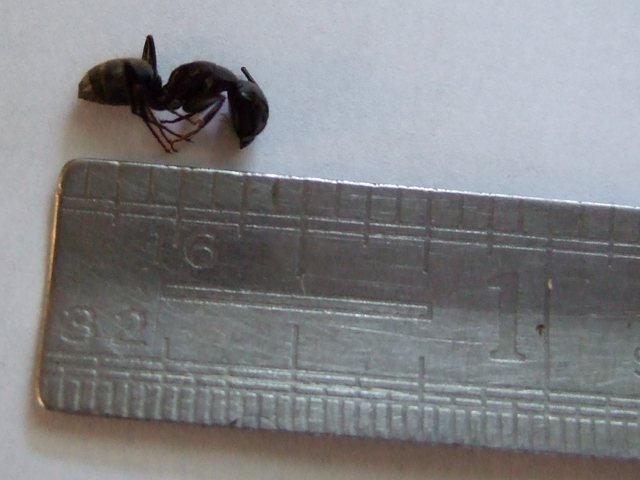
Ant control in Battle Creek, MI is really two jobs. The one that damages a house is the black carpenter ant, which does not eat wood but excavates smooth galleries through it, and it starts wherever wood has stayed wet: a leaking gutter line, a soft window sill, a porch column, a roof leak over a wall, an old tree stump near the foundation. Michigan gives them plenty of moisture. The one that annoys you is the pavement ant, trailing up through cracks in a basement slab and along the kitchen counter. Both live in colonies you cannot see, which is why spraying a trail accomplishes little. An experienced local exterminator finds the nest and treats it.
Carpenter ants and moisture
Carpenter ants want wood that has been softened by water. In Battle Creek that means sills and headers under a failed gutter, framing behind a slow roof leak, deck ledgers, porch posts sitting on damp ground, and the crawl space or basement rim joist. Outdoors they nest in stumps, dead limbs, and firewood stacked against the house, then run satellite colonies indoors.
The signs are coarse sawdust piles, sometimes with insect parts in them, a faint rustling in a wall, large winged ants indoors in spring, and workers moving at night. Damage is slow, but it compounds. Fixing the water is part of fixing the ants.
Pavement ants and slab cracks
Pavement ants nest under slabs, driveways, patios, and sidewalks, and push soil up through the seams. Indoors they trail through basement slab cracks and expansion joints toward greasy and sweet food. They are a nuisance rather than a structural pest, but the colony is under concrete and a repellent spray only scatters the foragers you can see.
Bait is what reaches the colony. Workers carry it home and share it, which is why a bait-led plan quietly reduces the population instead of pushing it into new places.
How treatment works
The exterminator locates the nest, indoors and out, by following trails and reading the moisture. Carpenter ants are treated at the galleries and the parent nest, with non-repellent products the workers carry back, plus targeted void treatment where a wall is involved. Pavement ants get bait placed on the trails and a non-repellent exterior perimeter.
Then the conditions get corrected: gutters and downspouts working, wood-to-soil contact removed, firewood moved off the house, limbs cut back from the roof, and the slab cracks and utility gaps sealed.
Call and connect with an experienced local exterminator.