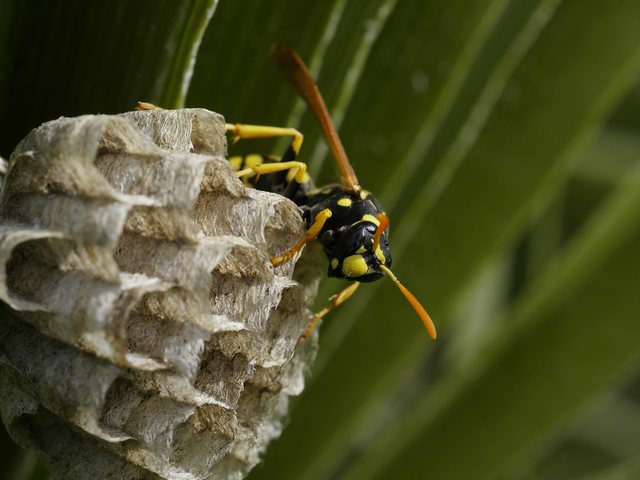
Wasp and hornet removal in Battle Creek, MI runs from late spring through the first hard frost, and it gets serious in August and September. Paper wasps hang their open, umbrella-shaped combs under eaves, porch ceilings, deck rails, grills, and mailboxes. Yellowjackets, the aggressive ground and cavity nesters, colonize wall voids, soffits, attic gaps, and abandoned rodent burrows, and by late summer a single colony numbers in the thousands. Bald-faced hornets build the large gray paper football in a tree or on a wall. All of them defend the nest, and yellowjackets sting repeatedly and are drawn to food, trash, and sugary drinks at exactly the time of year people are outside. An experienced local exterminator removes the nest safely and treats so new queens do not recolonize.
Knowing what you're dealing with
Paper wasps hang a small, open comb you can see under an eave or porch ceiling. They are the least aggressive but will defend it. Yellowjackets nest out of sight in wall voids, soffits, and ground burrows; a steady stream of insects going into one spot in a wall or the lawn means a hidden colony. Bald-faced hornets build the large enclosed gray nest in a tree or against a structure and are aggressive close to it.
A hidden yellowjacket nest inside a wall is not a do-it-yourself job. Disturbing one without the right products and protective gear provokes the whole colony, and people with sting allergies are at real risk.
Why late summer is the dangerous window
Colonies build all season. By August and September a yellowjacket nest is at maximum size, its natural food sources are declining, and workers turn aggressively toward protein and sugar, which is why they arrive at the picnic, the trash can, and the pop can. Aggression peaks right before the first hard frost ends the colony.
Nests are not reused the following year, but the same sheltered location gets chosen again by a new queen, which is why sealing matters after removal.
How removal works
The exterminator identifies the species and locates the nest, then treats and removes it with the proper products and protective gear. Accessible paper wasp combs are knocked down and treated. Hidden or ground-nesting yellowjacket colonies are treated at the entrance so foragers carry it in. Void treatment handles nests inside walls, soffits, and weep holes.
Old nests are removed and the gaps sealed at eaves, vents, soffits, and wall penetrations, so the spot is not chosen again next spring. Sealing a wall void before the colony is dead traps them, and they chew inward, so the sequence matters.
Call and connect with an experienced local exterminator.